

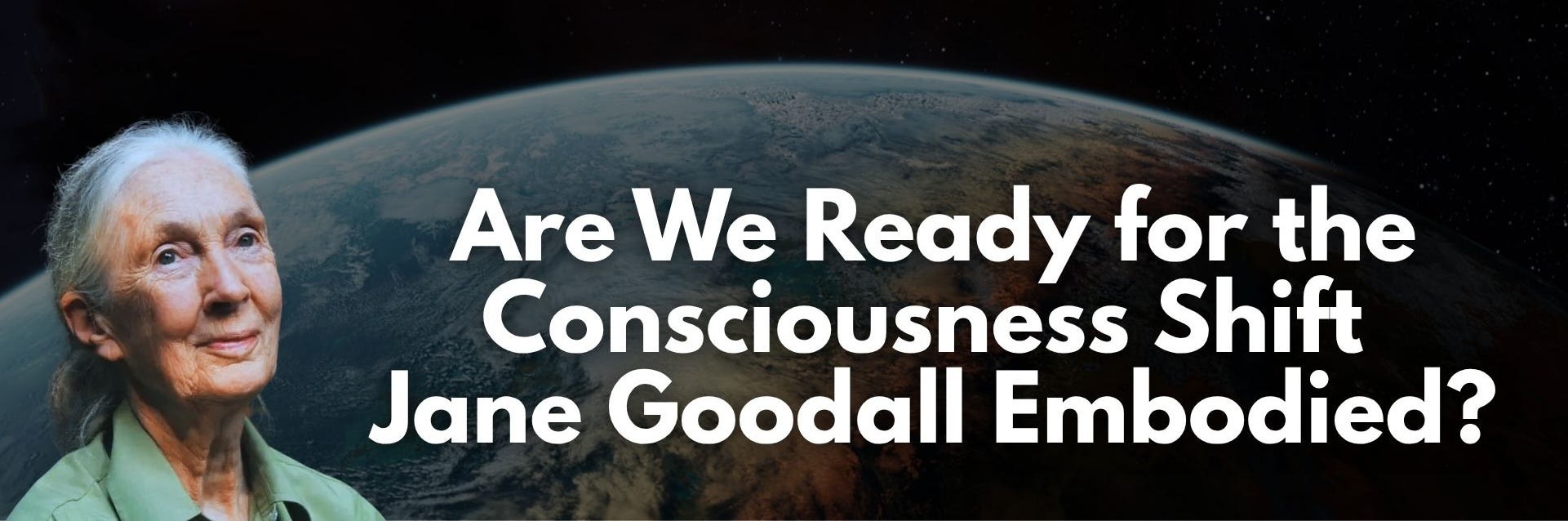
Jane Goodall is best known for her groundbreaking work with chimpanzees and her lifelong advocacy for animals and the environment. Yet beneath her scientific and humanitarian legacy lies something even deeper. In this piece, we explore two powerful invitations for humanity that Jane Goodall beautifully exemplified with her life’s work:
to be transformed by the mystical experience of awe and wonder
to engage across differences without enemy-making
Both speak to an evolution in consciousness beyond the illusion of separation. This separation lives not only in systems of power and wealth that exploit the world, but in the polarization and fear that shut down viewpoint diversity and turn us against one another.
Goodall embodied this shift through an activism that went beyond the reactivity and division defining modern activism, revealing that the deepest transformation begins with how we relate to one another and to life itself. This way of relating returns us to the deeper nature of reality we live in: the interdependent world that makes our very existence possible.
Transformed By The Mystical Experience of Awe and Wonder
In her memoir Reason for Hope: A Spiritual Journey, Goodall writes about a life-changing experience in 1974 sitting in the Notre Dame cathedral of Paris and hearing an organ playing Johann Sebastian Bach’s Toccata and Fugue in D Minor. For a moment, her mind gave way to something vast and overwhelmingly beautiful. She later described it as the closest she’d come to ecstasy, a word that comes from the Greek ekstasis: “to be or stand outside oneself.”
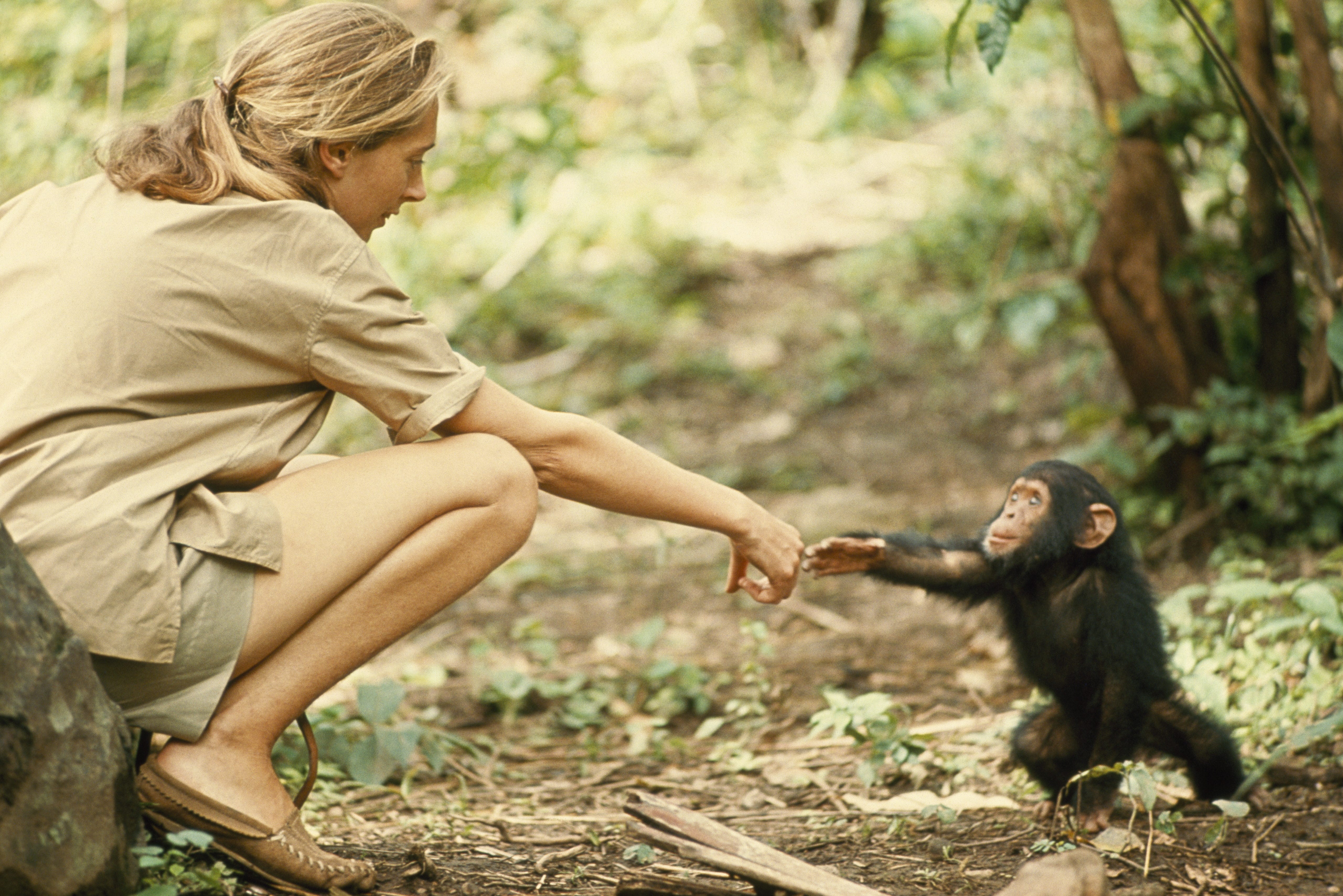
Years later, she would encounter that same profound experience in the forests of Gombe, Tanzania.
“Lost in awe at the beauty around me, I must have slipped into a state of heightened awareness. It is hard - impossible really - to put into words the moment of truth that suddenly came upon me then. Even the mystics are unable to describe their brief flashes of spiritual ecstasy. It seemed to me, as I struggled afterward to recall the experience, the self was utterly absent: I and the chimpanzees, the earth and trees and air, seemed to merge, to become one with the spirit power of life itself.
The air was filled with a feathered symphony, the evensong of birds. I heard new frequencies in their music and also in singing insects’ voices - notes so high and sweet I was amazed. Never had I been so intensely aware of the shape, the color of the individual leaves, the varied patterns of the veins that made each one unique.
That afternoon, it had been as though an unseen hand had drawn back a curtain and, for the briefest moment, I had seen through such a window. In a flash of “outsight” I had known timelessness and quiet ecstasy, sensed a truth of which mainstream science is merely a small fraction.
And I knew that the revelation would be with me for the rest of my life, imperfectly remembered yet always within. A source of strength on which I could draw when life seemed harsh or cruel or desperate.”
When we experience awe, the boundaries between “me” and “other” begin to dissolve. Psychologists at UC Berkeley’s Greater Good Science Center call this the “small self effect,” when our sense of self-importance surrenders to a self-transcendent state that can measurably change how we think, feel, and act.
Psychologists Dacher Keltner and Jonathan Haidt identified the phenomena of awe as encountering something so immense (physically or conceptually) that it exceeds our usual frame of reference: a profound experience in nature, a piece of music, stories of healing and transformation emerging in the most unlikely places, an idea or experience that changes what we believe is possible. Keltner and Haidt suggest that humans evolved to experience awe because it helps us take in new information and reshape how we understand the world. This mental flexibility not only allows us to adapt, learn, and survive, but it also opens us to higher human values: goodness, beauty, creativity, generosity, and gratitude.
“Awe is a lightning bolt that marks in memory those moments when the doors of perception are cleansed and we see with startling clarity what is truly important in life.”
– Psychologist David Elkins
Awe isn’t about being amazed or starry-eyed. When we bring curiosity and wonder into our activism and relationships as Goodall role-modeled for us, we are reminded that there’s more to life than our fears–especially when these fears are manipulated and exploited by a media machine driven by divisive propaganda that serves entrenched power.
How trustworthy is our certainty when it so often breeds the defensiveness and polarizing dialogue that leaves no room for nuance?
Emerging research into near-death experiences, consciousness, quantum science, and reported UFOs defying conventional understanding of physics suggest that the nature of reality is far more complex and mysterious than our existing frameworks can explain.
It might seem like a leap to connect this to today’s political turmoil dominating our screens. Yet our collective stories about today’s political conflicts—simplistic media narratives, partisan culture wars, identity politics–reveal just how narrow our frames have become. “Trust the science,” “The far-right is a threat to democracy,” “The radical left is destroying our country,” “Follow the experts,” “Fight fascism,” “Facts matter,” “My body, my choice,” “Make America Great Again.” Slogans can become a substitute for thinking deeper about what’s really driving today’s chaos. These simplified stories may be easy to digest, yet how much do we really understand about the hidden systems of corporate and political power that shape our world?
When we allow ourselves to be moved by wonder and curiosity in a world addicted to certainty and outrage, we begin shifting out of defensiveness and into a grounded openness. This openness has a ripple effect. It changes how we listen, how we speak, and how others feel in our presence. When we bring this state into our relationships or our activism, we become what psychologists call a “regulating presence,” the kind of person whose grounded energy helps others relax, think in new ways, open to goodness, and imagine new possibilities.
The Courage to Meet Difference Without Needing an Enemy
Jane Goodall’s work didn’t follow the easy path of righteous opposition that defines much of activism today. It instead unfolded by a more humbling, slower, and deeply human work of relationship.
Building relationships with people and companies on the other side was an approach that opened doors activism alone could not. She befriended James Baker, a devout hunter and former US Secretary of State, who used his diplomatic reach to open doors for her across Africa. She worked with Conoco, an oil company, to build a chimpanzee sanctuary that rescued hundreds of starving and orphaned chimpanzees.
It was Goodall that influenced the National Institutes of Health to end the use of chimpanzees in medical research.
“I lost a lot of friends because of going into the labs, sitting down and talking to the people, organizing a conference to bring in the lab people, the scientists and also the animal welfare people. There were a lot of animal rights people who refused to speak to me — they said, ‘Wow, how can you sit down with these evil people and have a cup of tea with them?’ I was totally and completely flabbergasted.”
“If you don’t talk to people, how can you expect them to change?” said Goodall. When speaking to the NIH, “I didn’t stand there and accuse them of being cruel monsters. I showed slides and some film of the Gombe chimpanzees and talked about their lives, and then showed some slides of the chimps in the small cages and said, ‘You know, it’s like putting a person in a prison like that.’ Many of the scientists said, ‘We really have never thought about this in this way’ a lot of them were actually crying. And so I think this began a different way of thinking … I’ve always believed that if you want somebody to change their mind it’s no good arguing, but you are to reach the heart.”
Her work poses an urgent question: How can our activism become a force for healing, not just opposition and resistance?
It serves the interests of the global elite who benefit from keeping us separate and disconnected, seemingly unable to work through and heal our differences. Yet I believe that human unity and common ground are the only real paths to freedom. What transforms a violent world isn’t just more negative news and the same old talking points. It’s the relationships that break the cycle of hate, fear, and dehumanization.
Thank you, Jane Goodall, for bringing so much humanity into the world of activism. Thank you for your gifts of civility and cross-species wisdom. May the spirit world welcome you home.
If you haven’t seen it yet, take a moment to watch this extraordinary video of Jane Goodall and Wounda, one of the many chimpanzees rescued and cared for at the Jane Goodall Institute’s Tchimpounga Chimpanzee Rehabilitation Center in the Republic of Congo.
With faith in a transforming world,
Amber Yang for PEERS and WantToKnow.info
WantToKnow.info is a nonprofit news information service founded by White House whistleblower Fred Burks in 2003, after he testified in a high-profile terrorism trial about how U.S. government officials repeatedly lied to the international press during his time as a language interpreter for presidents and top government officials around the world.
We go beyond today’s headlines to uncover the hidden forces shaping history and driving global events today, regardless of who’s elected in office. Our organization serves a dual purpose: exposing verifiable information on high level corruption and cover-ups and highlighting the best of humanity with solutions and stories that remind us of our innate goodness and collective power. We have a comprehensive database of over 13+ news articles, which has been used by thousands of journalists, researchers, and everyday truth seekers since our founding.
Subscribe to our free weekly newsletter here: https://www.wanttoknow.info/subscribe
Thank you also for your reply. You’ve helped me understand how those elite who put on a mask of do-gooders (and of course Goodall is not the only one) are able to get away it, where it’s due to the naivete of people such as yourself. Not sure if you read the obit which was published in a periodical from the African continent and written by someone whose name sounds Indian, but it provides a non-western perspective which is valid considering they are part of the non-elite that people like Goodall seek to eliminate in order to continually meet the needs and greeds of the elite’s lifestyles.
Having said that, please don’t think that I’m out to attack you in any way. In fact, I looked at the titles of some of the articles you publish, and I can see you guys are sincere good people. No, actually, it’s more than that – what you’re tackling is really remarkable and fantastic, and you head all that. In all honesty, I used to think the way you did about people like Goodall. I guess what I'm trying to do is share my own experience of being careful who to esteem. Otherwise, I think we’re actually mostly on the same page about things except that you are in fact actively doing a lot about it through your publication.
What an inspiring person!